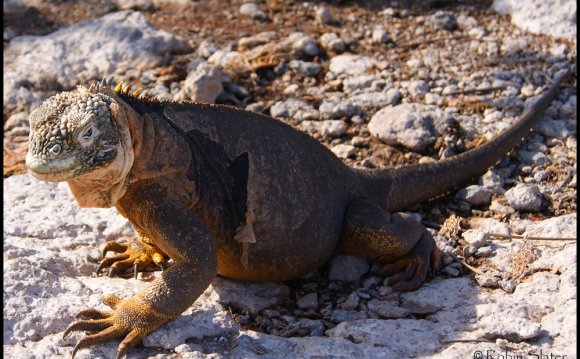
Galapagos Islands-Iguanas
IGUANAS WITH A PERMANENT SMILE | Ecuador Guide | Ecuador
International planning workshop took place inThe giant tortoise was one of the most devastated of all species in the Galapagos Islands. Only the rice rat was hit harder, with the…
There s no better laboratory for conservation and biology field studies than the Galapagos Islands. From the waters teeming with species found only here, to the highlands inhabited by giant tortoises, you ll work to understand and protect this fragile ecosystem. Get in Touch For Solo Students Galapagos Go Behind the Scenes &…
Read MoreThe Galapagos Islands are a natural wonder unlike any other place on the planet. The islands are a volcanic archipelago teaming with one-of-a-kind animals and plants, thanks to a very remote location more than 600 miles off the coast of Ecuador in the Pacific Ocean, and the fact that many species uniquely evolved since it’s…
Read MoreDr. Bohlin helps us understand the significance of the Galapagos Islands in the birth of the evolutionary theory of Charles Darwin. Based on personal observation on these unique isolated islands, he explains why he is not convinced that the animals of these islands make a case for the evolution of all living things. What’s So…
Read MoreNicknamed the “Gateway to the Amazon, ” Baños, Ecuador is in fact the home to much more. Located at the foot of the famous Tungurahua volcano and named after the town’s numerous thermal springs, Baños has become a popular tourist destination but still maintains its small town feel. Home to less than 20, permanent residents…
Read MoreOrthographic projection centred over the Galápagos. Main islands The archipelago has been known by many different names, including the Enchanted Islands because of the way in which strong, swift currents made navigation difficult. The first crude navigation chart of the islands was done by the buccaneer Ambrose Cowley in 1684…
Read MoreHigh Risk - Nearly all areas below 1500m including the Amazon Basin area, the risk is high and you will require one of the antimalarials, Malarone, Doxycycline or Lariam. For all other areas adopt bite avoidance measures. No risk in Galapagos islands, Quito or Guayaquil. High risk areas and Amazon Basin Region If you don t already…
Read MoreGalapagos Islands, Ecuador (map, info) The natural history of these islands is eminently curious Most of the organic productions are aboriginal creations, found nowhere else; there is even a difference between the inhabitants of the different islands; yet all show a marked relationship with those of America, though separated…
Read MoreADDRESS Canadian Embassy in Quito, Ecuador Av. Amazonas 4153 y Unión Nacional de Periodistas Eurocenter Building, 3rd Floor P.O. Box Quito Ecuador TELEPHONE (+593) (2) 245-5499 FAX (+593) (2) 227-7672 WEBSITE OFFICE HOURS 09:00 - 12:00 HEAD OF MISSION Pamela O’Donnell, Ambassador Facts about the Embassy Canada in Ecuador: In…
Read MoreAlert - Level 2, Practice Enhanced Precautions Watch - Level 1, Practice Usual Precautions What is the current situation? In December 2015, the first local transmission of Zika virus infection (Zika) was reported in the Caribbean. Local transmission means that mosquitoes in the area have been infected with Zika virus, spreading…
Read MoreQUITO A volcano perched atop one of Ecuador s Galapagos Islands erupted in the early hours of Monday, the local authorities said, potentially threatening a unique species of pink iguanas. The roughly 1.7-kilometer (1.1-mile) high Wolf volcano is located on Isabela Island, home to a rich variety of flora and fauna typical of…
Read MoreFamed Charles Darwin Research Station at Risk It’s often said that tourism is a two-edged sword. If so, then nowhere do both edges gleam more brightly and sharply than in the Galápagos. Now, with a weird, backhand snicker-snack, the tourism sword is slashing at the same renowned scientific institution that it has also helped:…
Read MoreDaniel Orellana of Charles Darwin Foundation crossing a field of ferns to reach Minas de Azufre (naturally-occurring sulfur mines) on the top of Sierra Negra, an active volcano on Isabela Island. The Google Maps team traveled for more than three hours, hiking and on horseback, to reach this remote location. Images, like the…
Read MoreCaudellia galapagosensis Landry & Neunzig, 2006 Unadilla maturella (Zeller, 1881) Hellula galapagensis Landry, 2008 Hellula phidilealis (Walker, 1859) Undulambia lindbladi Landry, 2006, femelle Undulambia lindbladi Landry, 2006, mâle Parapoynx fluctuosalis (Zeller, 1852) Références Landry, B.& H. H. Neunzig…
Read More